
Three weeks ago, I wrote that if you can reverse engineer it, it's open source. Looks like the frontier labs didn't love that idea.
Claude Code users are hitting "safety checks" in the middle of decompiling things. Some Codex users got warnings and account restrictions for poking at their own smart TVs. 404 Media calls it a crackdown on the coolest thing people were doing with AI and I agree with them.
This is precisely the reason why local AI and open source/weight models are going to be the next big thing for people who want control over their data and computer.
So this edition is about who gets to say 'no' on your machine.
🐧 AI at the core of new Linux distro
Remember Playtron, the Linux gaming OS from Cyanogen co-founder Kirt McMaster? It rebranded as Kora in July 2025 and has now unveiled Kora OS, a Linux desktop pitched at people who primarily use AI.
Here's the catch. Kora OS will be free when it ships in 2027, but the money comes from subscriptions that bundle AI models and agent services. Cortex and the desktop interface are proprietary. So it's Linux-based, not open, and only "local when possible".
Kora won't be the only one. Omarchy is already there and so do openKylin and openEuler. There will be more distros offering AI-first opearting systems.
🔐 Agent security
You know that "Yes, and don't ask again" option in Claude Code? It saves an allow rule in .claude/settings.local.json inside your project. Sometimes that rule is the exact command you approved, password or token included, in plain text.
Security firm Apiiro searched public GitHub and found 104,185 copies of the file.
The bug report about this goes back to August 2025. A bot closed it as "not planned" after 60 days of no activity. So the same tool that won't help you decompile your own TV firmware will happily remember your production database password.
🔍 Discover AI tools
Memory Poisoning Lab is an MIT-licensed teaching lab for memory poisoning attacks on AI agents. You replay six scenarios, try defenses and see what repair actually restores. It uses a scripted agent and synthetic data, so it runs offline with no API keys. There's a browser demo too.
TurboDiffusion is a video generation acceleration framework that can speed up end-to-end diffusion generation upto 100 times on a single RTX 5090.
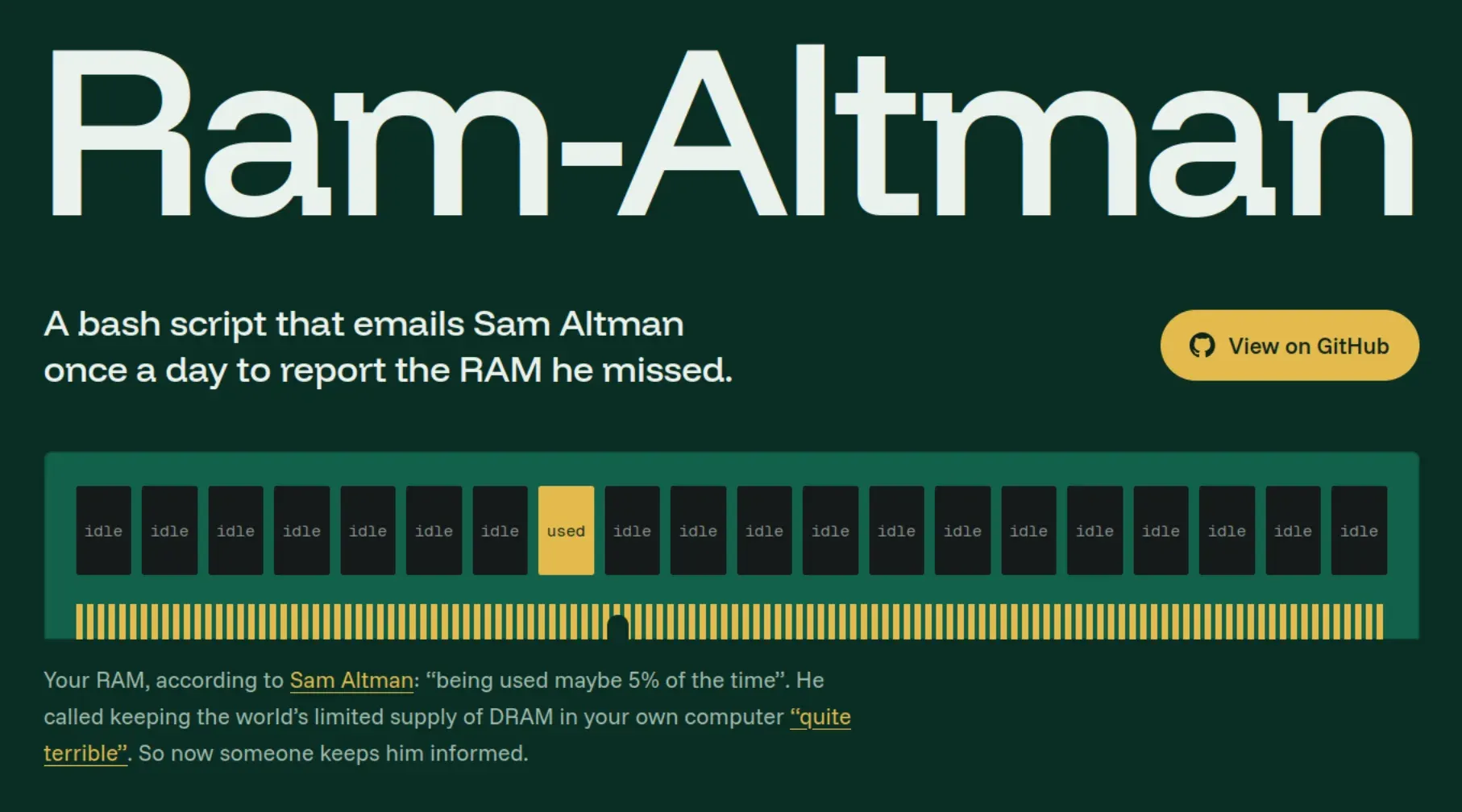
Ram-Altman relates to last week's edition. Since Sam Altman was unhappy with consumers not fully utilizing their RAMS, someone created a bash script you run from cron. Any day your Linux box has more than 10% of its RAM available, it mails Sam Altman a note. It's silly but awesome 😄
🗂 AI jargon: Abliteration
In AI, Abliteration is a way to remove the refusal behaviour from an open-weight model without retraining it. Researchers have found that refusals are typically tied to a single "direction" inside the model's activations. Find that direction, subtract it from the weights, and the model mostly stops saying no.
That's why you see "abliterated" versions of popular models on Hugging Face. You see, with open weights LLMS, the guardrails are yours to keep or remove. With a cloud model, they're someone else's call.
😂 Meme
In case you didn't know already, NVIDIA CEO Jensen Huang is accused of dating a Chinese spy.

See you next week 😄

from It's FOSS https://ift.tt/3xBiOEU
via IFTTT

Tidak ada komentar:
Posting Komentar