The GNU Affero General Public License version 3, or AGPLv3, is one of the strongest copyleft licenses in the open source world.
Published by the Free Software Foundation in 2007, it requires that any software built on an AGPLv3-licensed project must make its complete source code available under the same terms.
That applies even when the software runs as a network service rather than being distributed as a standalone binary. I say that because what follows are two violations that the Software Freedom Conservancy has dug out after investigating Bambu Lab.
What the investigation found
For context, Bambu Studio is the slicing software that ships with Bambu Lab's 3D printers. It is what translates a 3D model file into printable layers before passing the instructions along to the printer.
It was built on top of PrusaSlicer, which itself came from Slic3r. Both predecessors carry the AGPLv3, and so does every derivative built from them. SFC looked at both the userspace software and the firmware running on Bambu's devices and pointed out the violations.
The first is about libbambu_networking, a networking library that ships with Bambu Studio across Linux, Windows, and macOS. It handles all communication between the slicer and Bambu's cloud.
Bambu has never made the source code for it available, despite AGPLv3 requiring that any code distributed alongside an AGPLv3 project be released under the same terms. SFC says Bambu's own README has effectively sat with this admission for years now.
The second violation comes from how Bambu handled Paweł Jarczak, a developer who built a fork of OrcaSlicer that could communicate with Bambu's servers by studying the incomplete Bambu Studio source code.
He did not touch the proprietary library at all. Bambu still contacted him, demanded removal, and stated a cease-and-desist letter had been prepared, arguing its terms of service take precedence over the license.
You see the problem? The AGPLv3 explicitly says no one can place additional restrictions on the rights it grants. The SFC says going after Pawel the way Bambu did is itself a violation.
What's their new initiative about?
SFC's response is a new project called baltobu, short for "Bringing Affero Licensed Things (On)to Bambu Users." It lives on SFC's Forgejo instance and has three repositories, each going after a different piece of the puzzle.
reverse-networking is working to reverse-engineer the libbambu_networking library and produce a replacement. Since the binary is itself covered by AGPLv3, SFC's position is that anyone holding a copy has the right to examine and reverse-engineer it.
The second is orca-slicer-for-bambu, a soft fork of OrcaSlicer built to be compatible with Bambu printers, eventually replacing Bambu Studio for those who want out of the Bambu Lab walled garden.
Then there is viscose, a fork of Bambu Studio itself. Part of it is keeping a copy of everything Bambu publishes in case anything disappears, and the longer-term aim is a version that respects users' software freedom better than the upstream does.
The next steps
SFC is also committing to act as a watchdog on Bambu Lab going forward. The organization says it does not usually go looking for violations proactively, but it is making an exception here and will keep checking.
A standing committee on software freedom in the 3D printer space is planned as well, with details expected in June 2026.
The plan is to conduct monthly meetings, pulling in manufacturers, users, licensing experts, and software freedom advocates to track new issues and figure out what to do about them.
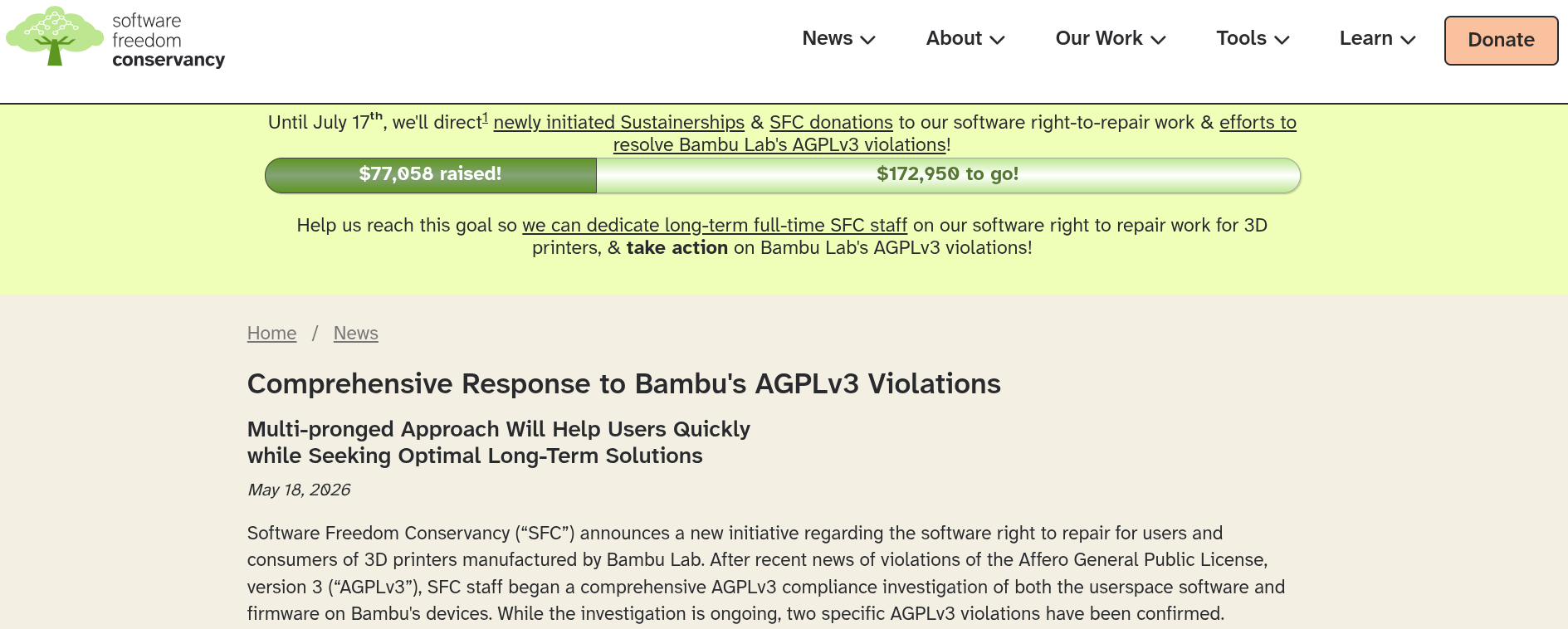
And there's also a fundraiser running until July 17, 2026, with a target of $250,007. If SFC hits it, the money goes toward hiring dedicated staff for this work long-term. If not, whatever is raised goes to existing staff time and related right-to-repair efforts.
Suggested Read 📖: Open Source Licenses Explained

from It's FOSS https://ift.tt/3cbCT5i
via IFTTT

Tidak ada komentar:
Posting Komentar