
When it comes to open source and AI, we almost always look West. While a lot happens in the United States and some in Europe, the East is not lagging either.
In the recently concluded LEAP East conference, several startups and enterprises came together to showcase their innovations and share what they were building.
Out of them, openEuler caught our attention for its focus on Open Source AI.
The SuperPoD
At LEAP East 2026, openEuler showcased its SuperPoD OS, which extends operating-system support for UnifiedBus-based SuperPoD computing systems.
Think of a SuperPoD as a cluster of several powerful computers that need to act like one giant machine. Running AI workloads takes computing power and doing it across hundreds of such machines is messy as they need to share memory, pass data around quickly, and not conflict with each other.
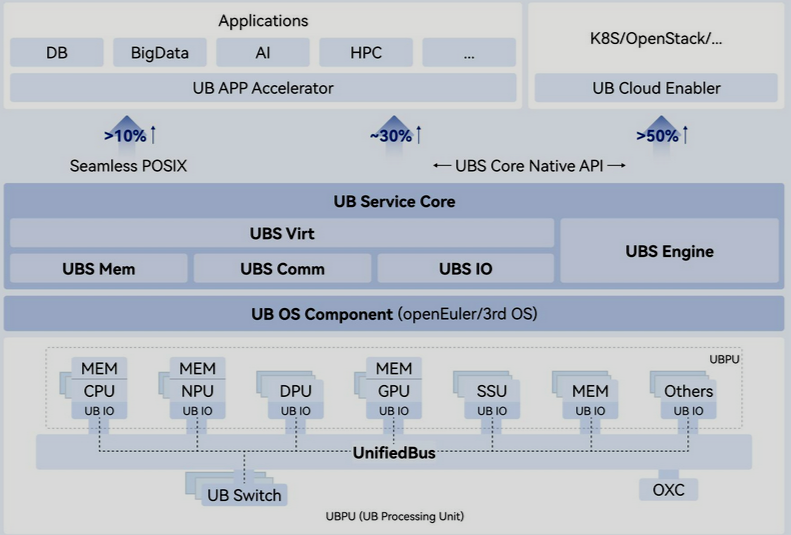
UB Service Core is the open-source software layer, part of the openEuler ecosystem, that makes coordination across those machines actually work. It provides five cluster-level system services for UnifiedBus-based SuperPoDs: Engine, Memory, Communication, I/O, and Virtualization.
The Engine pools memory and DPU resources across the cluster and schedules them dynamically. It also handles automatic failover so the system keeps running if a node goes down.
The Memory component lets machines within a UnifiedBus-based SuperPoD share and pool memory using unified-memory programming, meaning software can treat distributed memory as a single addressable space.
The Communication piece provides high-performance networking over UnifiedBus while staying compatible with standard Socket and Verbs interfaces, so existing applications don't need to be rewritten to benefit from it.
The I/O service handles global data read/write caching at a high level, which matters for workloads like AI inference that repeatedly access large shared datasets.
The Virt component covers virtualization pooling, decides live-migration policy (when and how to move a running VM to another machine), supports disaster recovery, and improves communication efficiency between VMs and containers.
Together, these five services give a SuperPoD cluster the coordination it needs to perform like a single well-organized system, with a claimed 30-50% performance gain over conventional architectures.
According to openEuler, UB Service Core can improve application performance by 30–50% by taking advantage of the peer-to-peer UnifiedBus interconnect architecture.
This SuperPod or UB Service Core is fully open source under the openEuler umbrella.
Agentic AI in the OS
openEuler is evolving toward an AgentOS model. In openEuler 24.03 LTS SP4, DevStation (desktop variant of openEuler) includes openEuler Intelligence, a desktop AI assistant that uses an agent runtime and MCP-based tools to support development and system operations.
Pre-built agent harnessing in the operating system is not uncommon these days. openEuler 24.03's built-in AI agent can be used to control the Linux system.
So, instead of doing things manually, by mouse clicks, you could just ask the agent to dim the brightness, lower the volume, or change the wallpaper. The built-in AI agent has custom skills to control the system settings in openEuler's UKUI desktop environment.
This is a work in progress. But the direction is clear. AI agent should soon be able to let you control the system instead of doing things manually.
Expanding into a community-based ecosystem
openEuler has launched openEuler Hong Kong User Group to bring together developers, researchers, and organizations in Hong Kong to connect, share experiences, and explore open-source innovation together.
openEuler is an open-source project incubated and operated by the OpenAtom Foundation. The community is expanding international collaboration through local user groups, industry partnerships, and participation in global open-source events. The Hong Kong User Group represents another step in openEuler’s efforts to encourage local participation and international collaboration.

from It's FOSS https://ift.tt/zqyrSpU
via IFTTT

Tidak ada komentar:
Posting Komentar