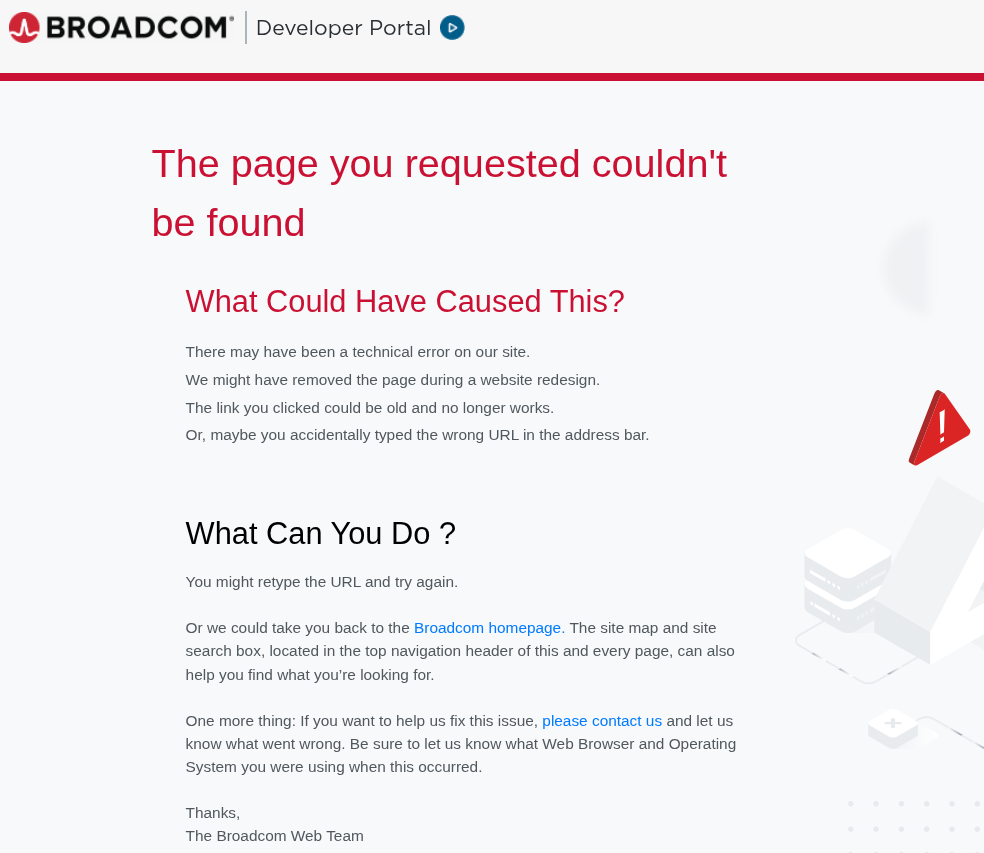
Broadcom has taken down the public download pages for the VMware Virtual Disk Development Kit (VDDK). The pages for VDDK 8 and 9, along with the landing page, now return a generic error message.
So far, there has been no formal announcement from Broadcom.
The removal was carried out sometime last month, as people on Reddit and vendor forums started reporting dead links in mid-August. ShapeBlue, an Apache CloudStack services firm, documented the change on August 25. Red Hat followed days later with a support note for its Migration Toolkit for Virtualization.
While existing copies will still be functional, meaning implementations that currently use VDDK will continue working as usual, those who want fresh copies are out of luck.
What's the fuss about?
The VDDK is a library that lets backup and migration tools read VMware virtual disks from outside the hypervisor. VMware launched it in 2008 as an easily accessible SDK for customers building disk utilities, and it soon became the backbone of image-level backups and agentless migrations.
Unfortunately, its license makes things complicated. The library cannot be redistributed, so no Linux distribution provides it, and no open source project can bundle it for users. Everyone has to point to Broadcom's download page, and that page is now gone.
Convenient, not for users but for VMware's owner, Broadcom, who has managed to cut off public access to a tool many relied on to move away from the platform.
The ones who are stuck
Microsoft's Azure Migrate documentation is one example of the disarray caused by the silence. It tells admins to download VDDK 8.0 or 9.0 from the Broadcom portal for agentless migration, and the links embedded there point to a page that isn't accessible.
The docs suggest falling back to agent-based migration if VDDK is unreachable.
Red Hat is in the same boat. Its support note reports customers hitting "not found" or "access denied" errors while trying to access the public download links for VDDK, further noting that it cannot host or redistribute the kit.
They are directing their customers to contact Broadcom support while the Red Hat Engineering team hunts for an alternative, long-term path out of this dilemma.
On Reddit, a user, bobdrakken, already did that, and what they received as a response ought to show you where Broadcom stands on this. 👇
Hi ****,
Greetings from Broadcom Customer Care.
To ensure the highest standard of security, reliability, and product features, the Virtual Disk Development Kit (VDDK) is no longer available for use or download.
Broadcom continues to actively maintain a variety of APIs and SDKs to enable authorized technology alliance partners to build backup and recovery software solutions that are validated and authorized to integrate, interoperate, or be compatible with Broadcom products.
For all backup and recovery requirements, customers should rely on such solutions from Broadcom authorized technology alliance partners."
I hope this helps you.
Please get in touch with your Partner for better assistance, since there is no pending action from our end hence this case will be archived now.
I would be glad to assist you if you have additional support requests.
A pattern unfolds
This takedown fits a pattern running since Broadcom closed its $69 billion acquisition of VMware in November 2023. The subscription-only overhaul followed within weeks, ending perpetual licenses and folding standalone products into bundles.
European customers later reported renewal prices climbing massively, enough to draw formal complaints from industry bodies.
It's not entirely been about extracting the maximum out of VMware; Broadcom has thrown in some goodwill along the way too. Workstation Pro and Fusion Pro went free for everyone in November 2024, and a free ESXi build returned in limited form in 2025.
Each move can be defended on its own; licensing overhauls and price changes are normal business; so is tightening download access.
But taken together, these paint a picture that while VMware itself is running just fine, the ones trying to move off VMware need to jump a few more hoops before they can achieve that.
Via: Virtualization Howto

from It's FOSS https://ift.tt/Dtd6BEZ
via IFTTT

Tidak ada komentar:
Posting Komentar