
Chromium's source tree has gained experimental support for packaging the browser as a Flatpak, and the change has already been merged yesterday.
It's a small addition, basically a commit sitting behind a disabled build flag, but it's the kind of change worth keeping an eye on if you've been wanting an official way to run Chromium or even Chrome through Flatpak on Linux.
Currently, the other instances of Flatpak packaging for Chromium are the unofficial community builds, one that's live on Flathub, and the other that's a de-Googled fork.
What's in the patch?
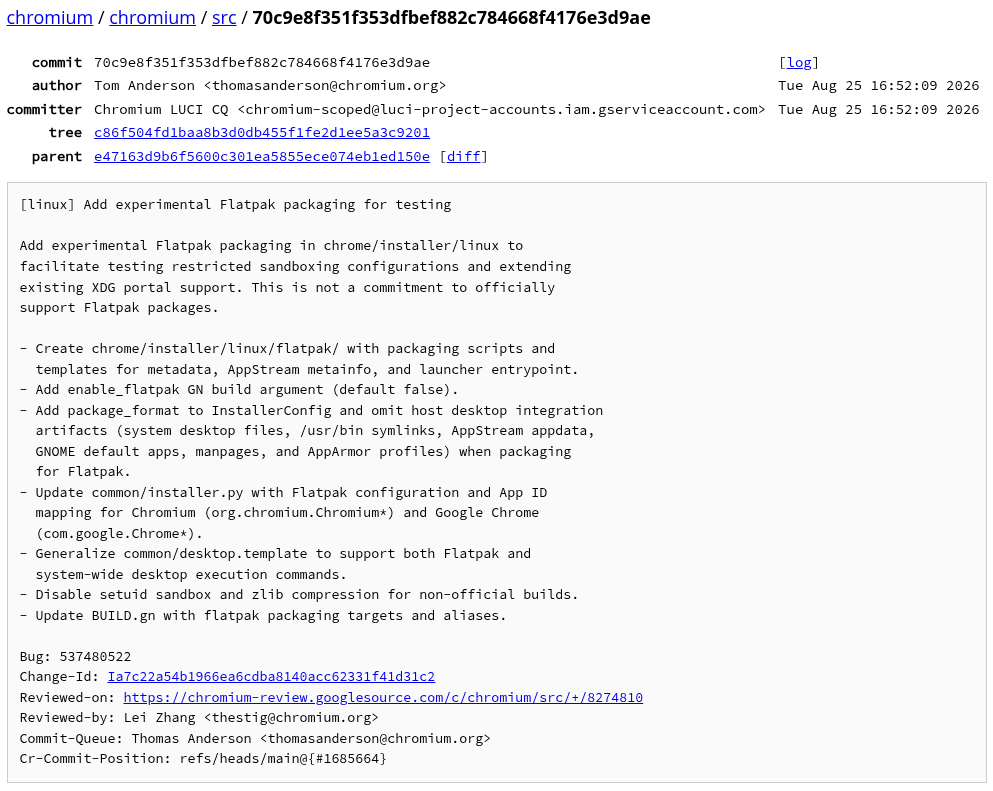
The new code lives in its own folder inside Chromium's Linux installer scripts, and it stays switched off by default behind a build flag: enable_flatpak.
Turning it on lets the build system put together a Flatpak version of the browser instead of the usual DEB or RPM package, leaving out desktop-specific components and system files that a Flatpak file does not need.
The goal, according to the patch author, Tom Anderson, is to test tighter sandboxing and improve how Chromium talks to the desktop through Flatpak's permission system.
Though he also points out that this is not a commitment from Chromium to ship an official Flatpak package.
An official Flatpak would be great
As mentioned earlier, if you want to install Chromium as a Flatpak, then the community-maintained build on Flathub and ungoogled-chromium are the most easily accessible ways to do so.
Both of those are quite popular among Linux users, and even if you don't consider the de-Googled offering's popularity, the community-maintained one is already averaging over 27,000 downloads a month.
An official package would mean people get the same Chromium experience on Linux, just served as a Flatpak, with Chromium's own developers handling sandbox permissions, updates, and desktop integration directly instead of leaving that work to open source contributors.
It doesn't stop at Chromium either; the patch already maps app IDs for both Chromium (org.chromium.Chromium) and Google Chrome (com.google.Chrome), so a Chrome Flatpak could realistically follow the same path if this ever ships.
It would also give Linux users one more straightforward way to install Chromium or Chrome, alongside the existing Snap (unofficial), DEB, and RPM options.
Where this leaves things
That said, Flatpak has its downsides. Flatpak apps tend to take up more disk space than traditional packages since they often ship their own libraries instead of sharing what's already on the system.
Flatpak's sandbox also restricts an application's access to files, devices, network resources, and other parts of the host system by default. Applications can request additional permissions when they need access to resources outside the sandbox, which adds another layer of configuration for users and developers.
None of that makes Flatpak a bad choice, but it does mean an official Chromium package would not automatically be everyone's preferred way to install the browser.
For now, this patch has a build flag turned off by default, nothing more. It does not confirm an official Flatpak is coming. But it's worth watching if this experiment ultimately holds up.
Via: Phoronix

from It's FOSS https://ift.tt/Z5v3uAd
via IFTTT

Tidak ada komentar:
Posting Komentar