Sipeed has been making tiny RISC-V and ARM boards for the maker crowd for years, and its NanoKVM line is already a familiar name if you have ever wanted BIOS-level remote access without paying enterprise IPMI prices.
Sipeed has announced a new entry in the NanoKVM line. It is called NanoKVM-Go, it is miniature and skips the usual pile of HDMI, USB, Ethernet, and power cables entirely. It comes with just USB-C cable to the target device and WiFi 6 for the connectivity. That's it.
The NanoKVM-Go is on Kickstarter and has already achived its funding goal by raising over a $130,000 against its target of approximately $6,000.
This tiny KVM also generated quite a buzz on Twitter, perhaps because it used the term "AI-native" in its campaign.
Yes, Sipeed is calling it the world's first "AI-native" KVM, built so that an AI agent can watch your screen and act on it at the hardware level. Interesting, right?
NanoKVM-Go Specifications
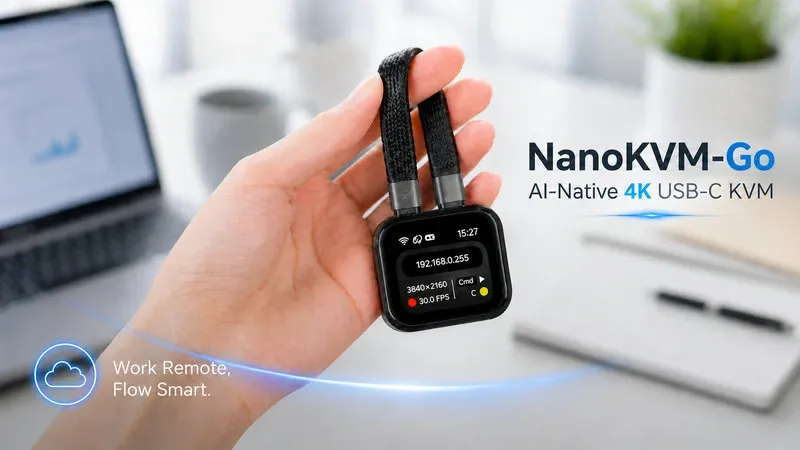
Here are the main hardware specifications for NanoKVM-GO:
- Single USB-C cable for video, audio, keyboard/mouse, power pass-through, and virtual disk
- 4K capture at 45Hz, 2K at 90Hz, latency as low as 60ms at 1080p
- Dual-band WiFi 6, up to 286Mbps, built-in Tailscale for remote access.
- KVM functions exposed as an MCP server for AI agents (for OpenClaw like AI agents)
- Go+ variant (comes with a built-in 3.2TOPS AI processor and PicoClaw) adds a local "Ambient Screen Intelligence" with 180-day searchable screen history
The device is priced to be $89 for Go and $129 for Go+. But if you back them in the crowdfunding campaign, you can get them for $69 and $99 respectively.
The main USB-C port on NanoKVM-Go carries video and audio (over DisplayPort Alt Mode), keyboard and mouse emulation, disk emulation for mounting OS images, and even a virtual network interface, all through that single cable. A separate auxiliary USB-C port handles power pass-through so your laptop or phone keeps charging during a long session.
It also powers an optional FingerBot accessory that can physically press a stuck computer's power button for a hard reboot. Yes, you read that right.
On the capture side, it does 4K at 45Hz or 2K at 90Hz, with latency Sipeed lists at 60ms for 1080p60, 80ms for 2K60, and 100ms for 4K30. That is over dual-band WiFi 6, rated up to 286Mbps, with Tailscale built in so you can reach the device remotely without setting up port forwarding.
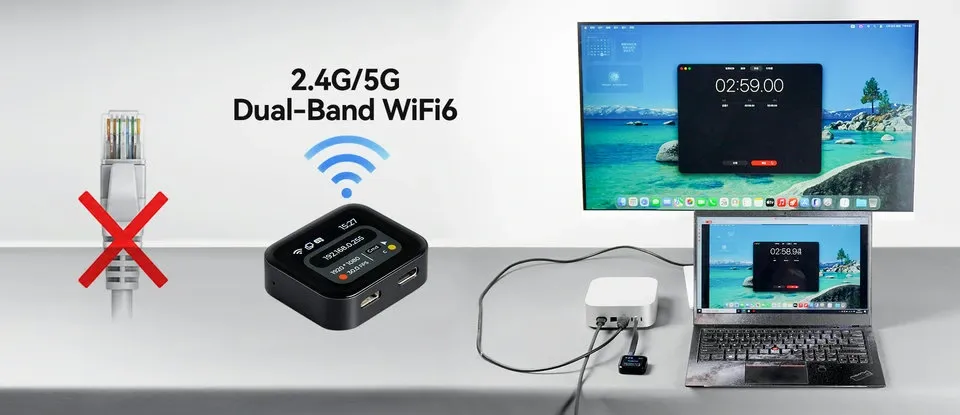
Since it works with anything that supports USB-C DisplayPort Alt Mode, that covers MacBooks, Mac minis, any laptop with USB C port, iPhone 15 and later, several Android phones, and even the Steam Deck.
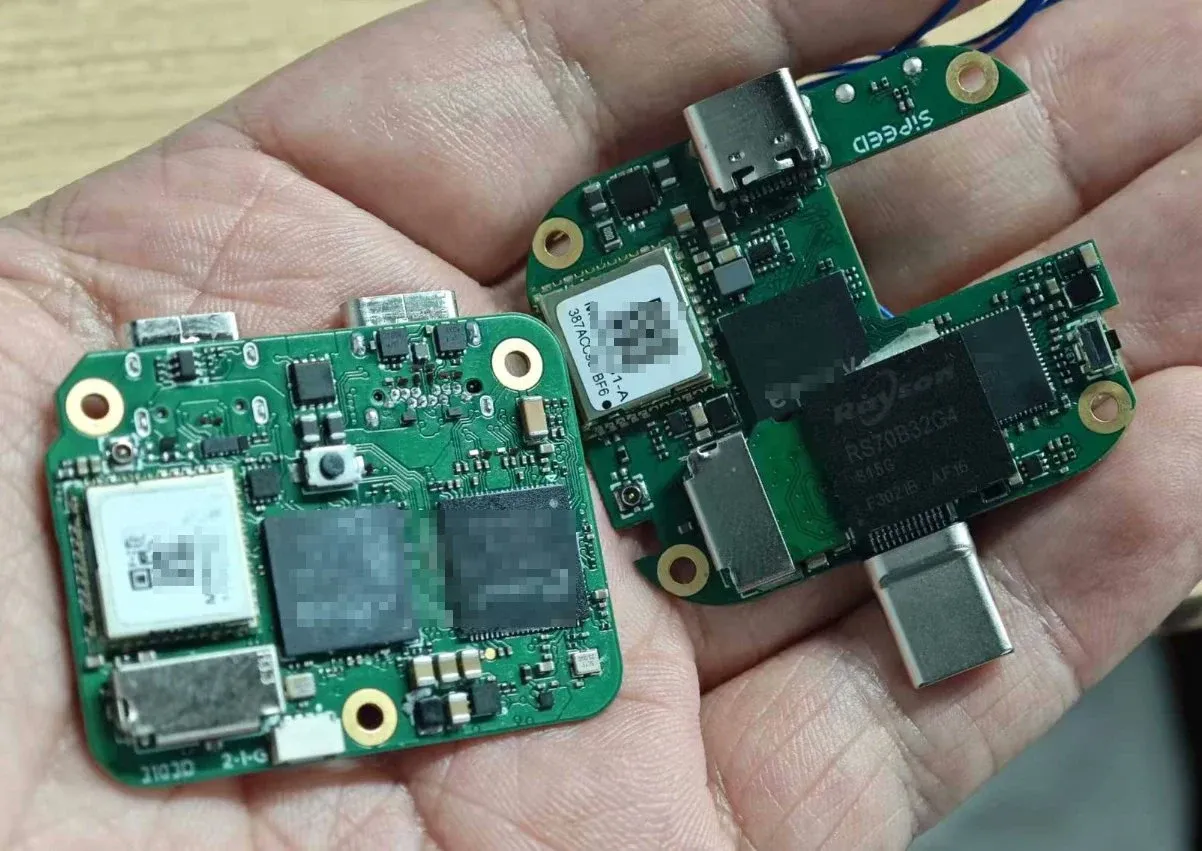
Under the hood is an unnamed SoC that is probably the same Axera Tech AX630C used in the existing NanoKVM Pro. It is paired with a dual-core Cortex-A53 and a 3.2 TOPS NPU. The base NanoKVM-Go gets 256MB of RAM and 16GB of eMMC storage, and the whole thing draws around 1.6W at 4K30.
NanoKVM-Go+
The NanoKVM-Go+ doubles the memory to 512MB and jumps to 64GB of eMMC, all in service of a feature Sipeed calls "Ambient Screen Intelligence,"which is basically its own version of the infamous Microsoft's Recall.
It continuously captures your screen, stores up to 180 days of history locally, and lets you search through it later with plain text, all processed on-device without cloud uploads or a subscription.
Whether you actually want a machine remembering everything on your screen for six months is up too you, but at least Sipeed is keeping it local instead of 'calling it home' like Microslop.
What could you use it for?
Well... remotely accessing and controlling your device is the most straight forward use.
Typically, you would need to install a remote desktop or remote access solution on the host system that you want to control. But with this gadget attached to the machine, it becomes a 'plug and play'. You can assist your elderly parents and friends (if they have devices with USB-C) or control your homelab devices from outside the home network.
Let's talk about the "native AI" feature. See, every KVM function, keyboard input, mouse control, screen capture, is exposed as an MCP server that you can turn on yourself. That effectively turns the device into a hardware-level Computer Use Agent peripheral.
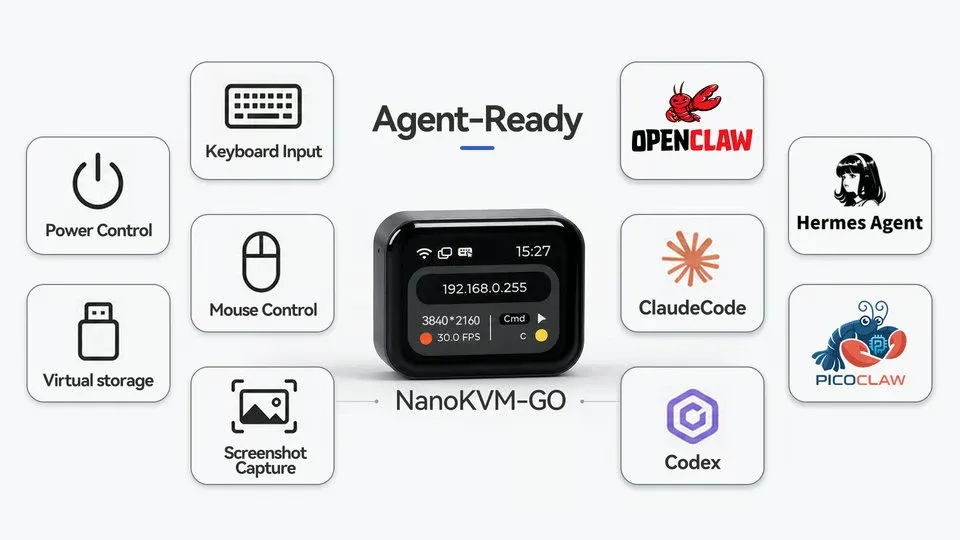
Instead of an AI agent needing screen-sharing software running on the target machine, it can drive the actual hardware through the KVM, which also means it works even if the target OS is frozen or sitting at a BIOS screen.
You can use Sipeed's own PicoClaw agent or go with OpenClaw, Claude Code, Codex, and Hermes Agent among other compatible options.
Sipeed is leaning on this to court the current wave of agentic AI tools, name-checking its own lightweight PicoClaw agent alongside OpenClaw, Claude Code, Codex, and Hermes Agent as compatible options.
The screen capture recall feature of Go+ is also helpful.
If you are running AI agents, you can let them run with your laptop lid closed (that's the running joke in the industry).
The announcement video could give you more ideas:
🛒 Pricing and Availability
NanoKVM-Go is live on Kickstarter now, and it's already comfortably funded past its original $50,000 HKD (about $6,374) goal.
The Early Bird tier for the base NanoKVM-Go is going for $69 (instead of $89), and the Super Early Bird for NanoKVM-Go+ is $99 (instead of $129). Shipping adds roughly $20 for international backers, and rewards are expected to go out in August 2026.
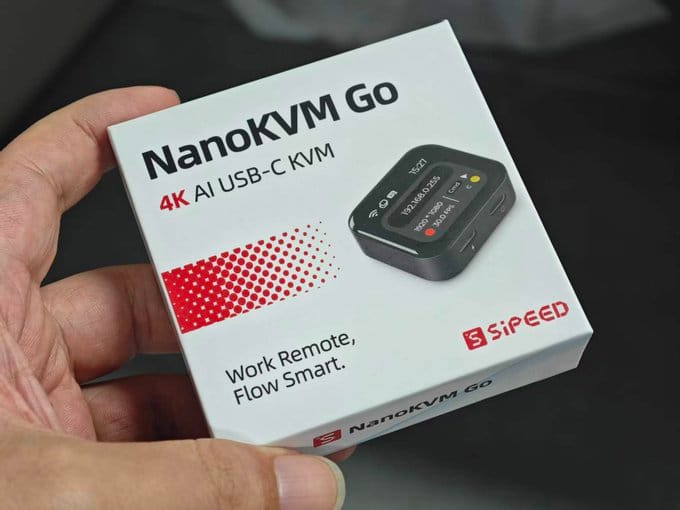
If you want to use this device in your AI workflow, go for the Go+ version.
Suggested Read: If KVMs are your thing, we also covered the LeafKVM, an open source Rust and Buildroot based KVM-over-IP device that takes a very different, fully open approach.

from It's FOSS https://ift.tt/63IChJH
via IFTTT

Tidak ada komentar:
Posting Komentar