AI has been creeping into everything, and the Linux ecosystem is no exception. Over the last couple of years, local AI has gone from a niche curiosity to something people can actually run on their machines.
On the user side, tools like Ollama and LM Studio have made it surprisingly straightforward to pull open-weight models and run them locally without requiring a cloud subscription.
For enterprises, solutions like RHEL AI and SUSE Linux Enterprise Server have been catering to organizations that want AI woven into their infrastructure.
Now, it looks like Canonical is jumping onto the bandwagon, as Ubuntu moves towards AI, and before you start calling it Ubuslop or something along those lines, understand how they are going about this.
What's happening?
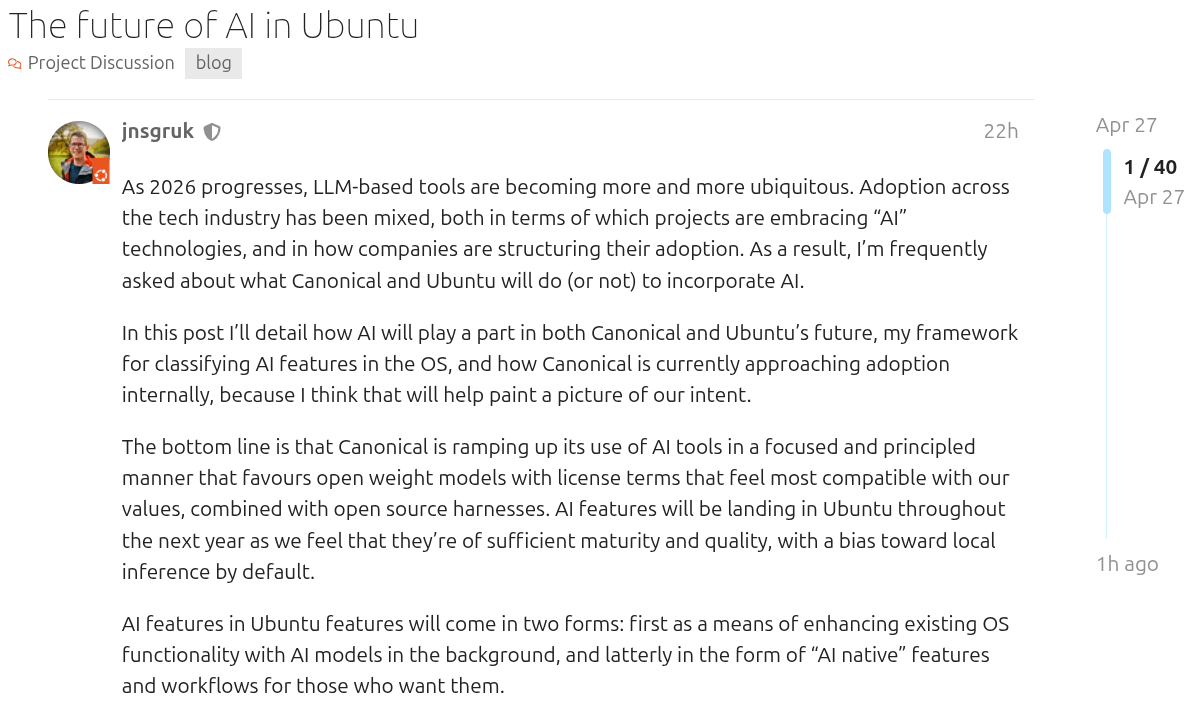
Jon Seager, VP of Engineering at Canonical, has published a post on Ubuntu Discourse laying out the company's AI roadmap. The short version is that AI is coming to Ubuntu; it will be local-first, and it will be built around open-weight models and open source tooling.
He laid out a framework distinguishing between two kinds of AI features, implicit and explicit. Implicit AI is about making existing OS features smarter in the background without requiring users to learn anything new or interact with anything that looks like AI.
He gave the examples of speech-to-text and text-to-speech, both of which can be improved using local inference with open source inference tools and open weight models, running entirely on-device.
Explicit AI features are a different story. These are the more obviously AI-centric, agentic workflows that could automate troubleshooting, create documents or applications, and run scheduled maintenance on a fleet of machines.
Jon also gave everyone a look at what it could look like in practice:
Imagine being able to ask your Linux machine to troubleshoot a Wi-Fi connection issue, or to stand up an open source software forge that’s pre-configured, secured, and reachable over TLS.
One could easily imagine using such a capability as a gateway for controlling your Linux machine from other devices through a variety of mediums - be that a mobile app, text messaging, voice commands or otherwise.
The delivery mechanism for all of this is inference snaps. Rather than asking users to wrangle separate tools, sift through Hugging Face, and figure out which model format works on their hardware, Canonical wants a simple snap install to handle everything, with hardware-optimized builds served based on your silicon.
And since snaps carry the same confinement rules as everything else in the ecosystem, the models are sandboxed and cannot freely reach into your files or data.
Makes sense, I guess?
The local inference approach is what makes this worth paying attention to. The default is not a cloud call to some API that logs your prompts and charges you per token. It runs on your hardware, stays there, and does not require signing up for anything.
Of course, cloud and external services are still an option, but only as a fallback for people who specifically need them, not the assumed path. That is a bigger deal than it sounds, btw.
Most AI integration announcements from Big Tech players start from the opposite assumption—cloud first, local maybe someday.
Should you be worried?
When Linux and AI are mentioned in the same breath, your mind might naturally draw a comparison to Microsoft's infamous Copilot offering, where the default experience is cloud, the model is proprietary, and half the features quietly require a Microsoft account.
What Jon is proposing keeps the user-facing, agentic stuff strictly opt-in. The implicit features would run quietly in the background and improve things you already use. Nobody is bolting a chatbot sidebar into GNOME and calling it a "productivity feature."
But, as things go with roadmaps, decisions shift under pressure and user expectations change over time. I suggest keeping a close watch on how things develop for the rest of the year.

from It's FOSS https://ift.tt/D7ZWkeo
via IFTTT

Tidak ada komentar:
Posting Komentar